Search
In Sessionwire, you can describe a sound, or drop in a track, and find music like it. You can also describe the person you need. Search is free to use, and running it costs Sessionwire under $30 a month.
I've led development at Sessionwire since 2017. I built search there in 2025 and rebuilt how it finds people in July 2026.
before
People search only matched usernames, which wasn't much use. Members wanted to type what they needed in plain words: “a drummer in New York” or “someone with a recording studio who likes hip-hop”.
what changed
- Places
- On 11 test searches that named a place, the share of people found in that place went from 67% to 91%. For “producer in LA”, 0 of the top 8 were in Los Angeles before and 8 of 8 after. Measured on 16 July 2026.
- Sound
- Describe a sound, like “indie folk with vocal harmonies”, and get back music that members chose to share. Every result shows who made it, a preview to play and a link to their profile.
- Drop a track
- Drop in a track up to 10 minutes long and get music that sounds like it. Your track is used for that search only and deleted after 24 hours.
- People
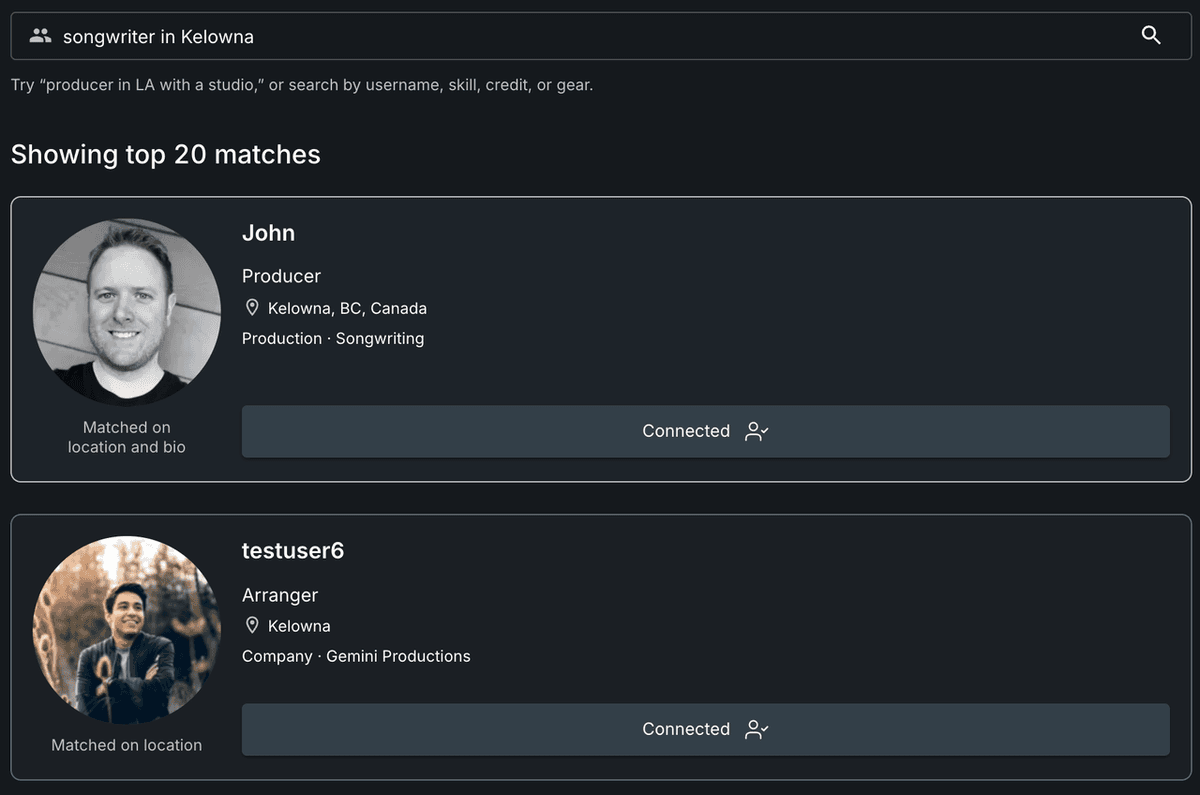
- Describe who you need. Each person found shows why they matched: their location, a skill or their bio.
- Cost
- Free to use: signing up to Sessionwire and searching cost nothing. Running it costs Sessionwire under $30 a month. The servers that analyze sound run only while someone is searching. That keeps them inside the $30 of free credit a month from Modal, the service they run on. Matching people has stayed inside Voyage's free tier.
- Size
- 385 tracks from 150 members, 330 of them shared to search, on 25 September 2026. 1,000 sample clips of 30 seconds were added so the first searches had something to find. They are labelled, and hidden unless you turn them on.
the decision
The budget was close to zero. So the sound models run on Modal only when someone searches, and shut down when nobody does. That keeps them inside Modal's free monthly credit. The price is a wait on the first search after a quiet spell. I chose that on purpose.
Each kind of search uses a model made for it. CLAP matches words to sound. MERT compares one piece of music with another. Voyage matches the words of a search to profiles by meaning. I tried CLaMP 3 first, in June 2025, and moved to CLAP the next day because it was smaller and faster.
In July 2026 I rebuilt people search. Matching by meaning alone missed exact words, like a skill or a piece of gear, and keywords alone missed what people meant. Now it runs both and merges the two lists by rank.
I also hid profiles with nothing to match. 93% of active accounts had only a name and a location, so a click on one led nowhere. On a copy of production on 16 July 2026, that took the searchable set from 20,054 profiles to 1,452. Filling in any one field brings a profile back. I also took the match percentages off results, because they suggested more precision than the search has.
how it works
A sound search takes this path.
- aska description, or a track up to 10 minutes long
- analyzeCLAP for words, MERT for a track, on Modal GPUs
- matchMongoDB Atlas, against tracks members shared
- showwho made it, a preview, a link to their profile
The detail: each shared track keeps its CLAP and MERT results with the file, so only your search has to be analyzed. People search runs a keyword search and a meaning search at once, and merges them with reciprocal rank fusion.
what went wrong
Testing the new people search against production data, “producer in LA” returned people in Indiana. The keyword search read “in” as the state code IN. The standard English setting fixed that and broke something else. It shortened “Las” to “la”, so the same search returned Las Vegas. I wrote a setting that skips small words like “in” and still treats “mixing” and “mix” as one word.
LA was still wrong. A profile says “Los Angeles, CA”, never “LA”, so the keyword search matched Louisiana instead. I added a short list of place abbreviations, such as LA and NYC, and that gave the 67% to 91% above. Searching deeper was the other option. I measured it: still 67%, and twice as slow, so I didn't ship it.
The labels that say why a person matched had a similar bug: the “in” inside “mixing” labelled results “matched on role”. They now match whole words only. All of this went out in two releases on 16 and 17 July 2026, the same week as the call rebuild.
limits
Sound results don't say why they matched. People results do. Sound search is marked beta in the app, and it has no quality test yet. The 67% to 91% covers people searches that name a place. The catalogue is small: 330 shared tracks. If nobody has searched for a while, the first sound search waits while the models start. After that, a search takes a few seconds.
more
- Sessionwire
- The product, year by year.
- Call rebuild
- How Call rebuild changed Sessionwire's calls in July 2026.
- Triage
- How Triage finds why something broke, and how I tested it.
- Remote control
- How Remote control lets you run someone else's computer in a Sessionwire call.